The Transatlantic Slave Trade and the Forced Removal of Africans to the Americas
Written by W. N. Walker
The modern world did not emerge by accident. It was engineered, financed, and built through systems of extraction, exploitation, and racialized violence. At the center of that system sits the Transatlantic Slave Trade, one of the largest forced migrations in human history and the foundation upon which the economies of Europe and the Americas were constructed.
From the 16th through the 19th centuries, more than twelve and a half million African men, women, and children were forcibly removed from their homelands and transported across the Atlantic Ocean. Millions did not survive the journey. Those who did were sold as property and compelled to labor under regimes of terror that enriched empires and corporations while permanently reshaping global power.
This was not a side chapter of history. This was the engine.
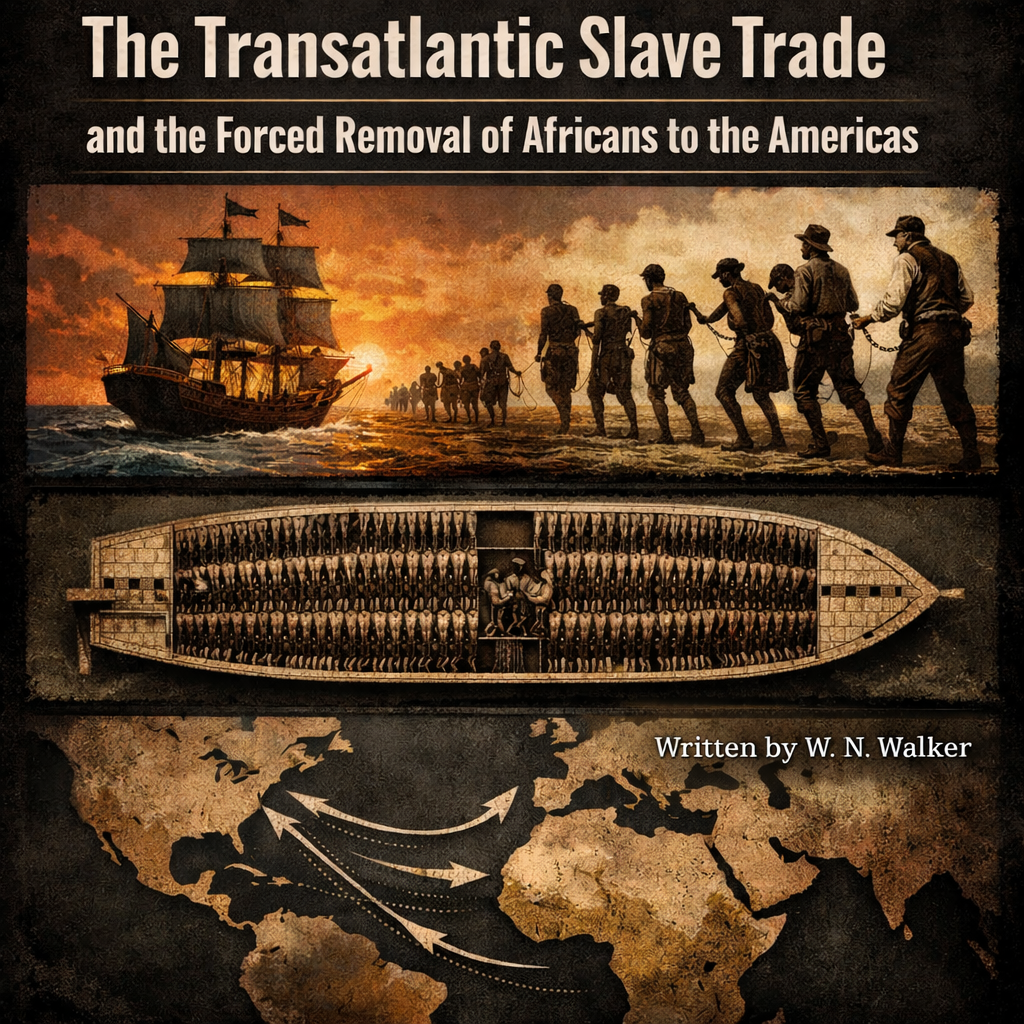
The Transatlantic Slave Trade functioned through an organized, multinational system often described as the triangular trade. European powers including Portugal, Spain, Britain, France, and the Netherlands financed and operated the trade. Ships left Europe carrying manufactured goods such as weapons, textiles, and alcohol. These goods were exchanged on the African coast for human beings, many of whom were captured through warfare, raids, or betrayal fueled by European demand. The ships then crossed the Atlantic to the Americas in what became known as the Middle Passage. The final leg returned European ships home with sugar, cotton, tobacco, rice, coffee, and other commodities produced by enslaved labor.
The Middle Passage was a site of mass death. Africans were packed into ships with barely enough space to sit or lie down. Disease, starvation, dehydration, sexual violence, and brutality were routine. Scholars estimate that between 1.8 and 2.4 million Africans died during the Atlantic crossing alone. Many resisted. Some jumped overboard. Others organized revolts at sea, despite overwhelming odds.
The scale of this violence is documented and measurable. The Trans-Atlantic Slave Trade Database, maintained by an international team of historians, records over 36,000 documented slave voyages and confirms that Brazil and the Caribbean received the majority of enslaved Africans, not the United States. This matters because it exposes how widespread and global this system truly was.
Supporting source: https://www.slavevoyages.org
The forced removal of Africans devastated entire regions of the African continent. Societies were destabilized. Economies were distorted. Political systems were undermined. The long-term consequences of this extraction are still visible today in patterns of underdevelopment, conflict, and economic dependency. This was not simply labor theft. It was demographic destruction.
In the Americas, enslaved Africans were stripped of language, kinship ties, religion, and legal personhood. Laws defined them as property. Children inherited enslaved status at birth. Violence was not incidental to slavery; it was the mechanism that sustained it. Whippings, mutilation, family separation, and sexual exploitation were tools of economic control.
The wealth generated by enslaved labor financed banks, universities, insurance companies, ports, and industrial expansion across Europe and North America. Institutions still operating today directly benefited from this system. This is not speculation. It is documented history.
Supporting source: https://www.britishmuseum.org/collection/galleries/africa
Supporting source: https://www.history.com/topics/black-history/transatlantic-slave-trade
Attempts to frame the slave trade as a tragic but distant past ignore its ongoing consequences. The racial hierarchies created to justify slavery did not disappear when the trade was abolished. They evolved. Systems of segregation, colonialism, Jim Crow laws, and mass incarceration are not historical coincidences. They are adaptations of the same logic that once declared African lives expendable for profit.
The abolition of the transatlantic slave trade did not end slavery itself. Many nations outlawed the trade decades before they abolished slavery, allowing existing enslaved populations to continue laboring under bondage. Even after formal abolition, illegal trafficking persisted. Resistance from enslaved Africans, not moral awakening, was the primary force that destabilized the system. Revolts, escapes, cultural survival, and intellectual resistance were acts of defiance that history too often minimizes.
Supporting source: https://www.nps.gov/articles/transatlantic-slave-trade.htm
Understanding the Transatlantic Slave Trade is not about assigning guilt to individuals today. It is about truth. It is about acknowledging that modern wealth, borders, and racial disparities did not arise naturally. They were produced through policy, profit, and violence.
Any honest conversation about civil rights, economic inequality, or global power must begin here. Before laws were written to exclude Black people, before marches filled the streets, before freedom was demanded, Africans were taken in chains and turned into capital.
This is not ancient history.
This is the foundation.
And until it is fully understood, the world will continue to struggle with the consequences of what it refuses to confront.