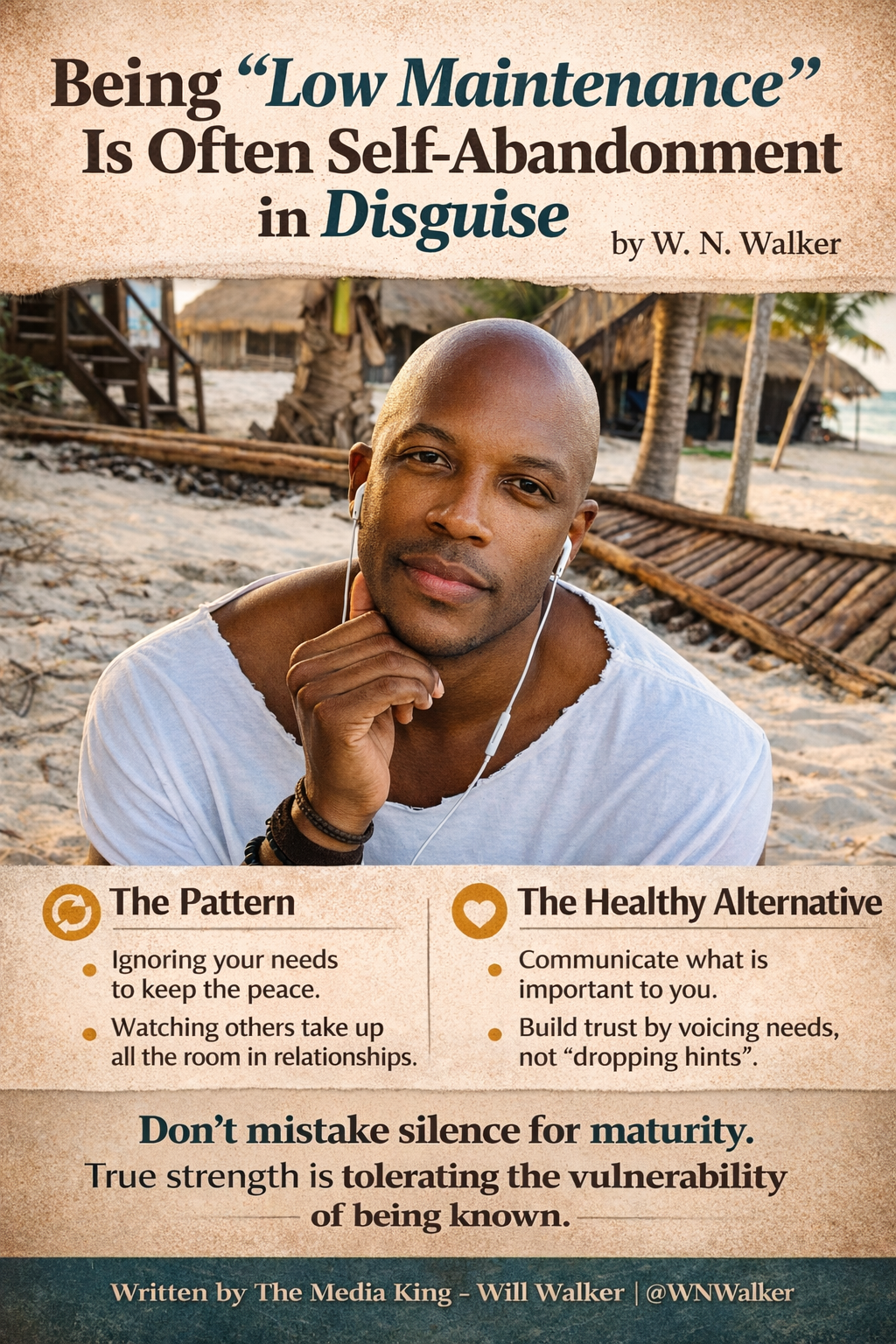
Being “Low Maintenance” Is Often Self-Abandonment in Disguise
After 50 years of practicing psychiatry, let me tell you something gently… and clearly.
“I’m just low maintenance” is rarely about emotional strength.
More often, it’s about fear.
And I don’t say that with judgment. I say it with compassion. Because I’ve watched thousands of intelligent, capable adults build entire identities around being easy to love.
It almost never starts that way.
Where “Low Maintenance” Actually Comes From
No one is born minimizing their needs.
Children are not low maintenance. They cry. They reach. They demand connection. They ask for reassurance without apology.
Somewhere along the way, many of us learned that expressing needs led to one of three outcomes:
We were ignored.
We were criticized.
We were punished emotionally.
So we adapted.
We became agreeable. Independent. Undemanding. “Mature for our age.”
What I’ve observed over decades is that many self-described low-maintenance adults were once children who realized very early that their needs were inconvenient to someone important.
And so they stopped having them. At least publicly.
That is not personality. That is adaptation.
The Psychology Behind Self-Silencing
When you repeatedly override your own emotional needs to maintain connection, you are engaging in what we clinically refer to as self-abandonment.
Self-abandonment is not dramatic. It’s quiet.
It sounds like:
“It’s not a big deal.”
“I don’t want to make this into something.”
“I’m fine.”
It often shows up in relationships where one partner takes up more emotional space and the other consistently contracts.
Over time, something predictable happens.
Resentment builds.
Anxiety increases.
Intimacy decreases.
Because intimacy requires authenticity. And authenticity requires risk.
If you never risk expressing disappointment, longing, insecurity, or desire, you may preserve the relationship… but you sacrifice depth.
And eventually, you sacrifice yourself.
The Difference Between Emotional Security and Emotional Withdrawal
This distinction is critical.
Emotionally secure individuals do not require constant reassurance. They tolerate discomfort. They regulate their feelings.
But they still communicate.
They still say, “That hurt.”
They still say, “I need more consistency.”
They still say, “I miss you.”
Emotional withdrawal, however, is a protective maneuver. It looks calm on the outside. Internally, it is hypervigilance.
Many “low maintenance” individuals are not calm. They are scanning.
Scanning for shifts in tone.
Scanning for signs of rejection.
Scanning for the moment they may become “too much.”
That level of monitoring is exhausting.
And it is often mistaken for independence.
The Long-Term Psychological Cost
Over decades, I have watched this pattern lead to very predictable outcomes.
Chronic low-grade resentment.
Emotional numbness.
Difficulty identifying personal desires.
Anxiety in close relationships.
Depression masked as fatigue or apathy.
When you chronically suppress needs, your nervous system does not interpret that as maturity. It interprets it as threat.
Your body keeps score.
You may pride yourself on asking for nothing. But the psyche does not operate on pride. It operates on truth.
And the truth is that humans require connection, reassurance, affection, and attunement.
Needing these things does not make you dramatic. It makes you neurologically intact.
Why We Confuse Self-Abandonment with Strength
Culturally, we reward low needs.
We praise the partner who “doesn’t nag.”
The employee who “never complains.”
The friend who “just goes with the flow.”
But from a mental health perspective, flexibility is healthy. Self-erasure is not.
When someone repeatedly minimizes their needs, I often ask a simple question:
“If your needs truly didn’t matter, why do you feel relief when someone finally meets them?”
That pause usually tells me everything.
What Healthy Expression Actually Looks Like
Healthy emotional functioning is not about becoming high maintenance.
It is about becoming honest.
That might sound like:
“I don’t need constant reassurance, but I do need consistency.”
“I value space, but I also need regular connection.”
“I try to be easygoing, but this actually matters to me.”
Notice the difference.
There is no accusation. No drama. No demand.
Just clarity.
Clarity builds intimacy.
Silence builds distance.
A Gentle Reality Check
If you describe yourself as low maintenance, I invite you to reflect on this:
Do you truly have fewer needs?
Or have you simply trained yourself not to voice them?
There is a profound difference.
Emotional maturity is not about needing less.
It is about tolerating the vulnerability of being known.
And being known requires allowing others to see your wants, your disappointments, and your preferences without apologizing for their existence.
After 50 years of clinical work, I can assure you of this:
The individuals who build the healthiest relationships are not those who need nothing.
They are those who communicate something.
And they do so without shame.
If you find yourself constantly being “the easy one,” it may be worth asking whether you are preserving peace at the expense of authenticity.
You deserve relationships where you do not have to disappear to be loved.
Written by The Media King – Will Walker | @WNWalker